November 2005
Fisk book
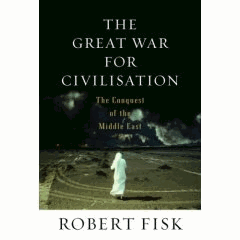
The Great War for Civilisation: The Conquest of the Middle East
by Robert Fisk
exec/obidos/tg/detail/-/1400041511/qid=1132033530/sr=2-1/
ref=pd_bbs_b_2_1/104-4923992-2083911?v=glance&s=books
Editorial Reviews:
From Publishers Weekly
Combining a novelist's talent for atmosphere with a scholar's grasp of historical sweep, foreign correspondent Fisk (Pity the Nation: The Abduction of Lebanon) has written one of the most dense and compelling accounts of recent Middle Eastern history yet. The book opens with a deftly juxtaposed account of Fisk's two interviews with Osama bin Laden. In the first, held in Sudan in 1993, bin Laden declared himself "a construction engineer and an agriculturist." He had no time to train mujahideen, he said; he was busy constructing a highway. In the second, held four years later in Afghanistan, he declared war on the Saudi royal family and America.
Fisk, who has lived in and reported on the Middle East since 1976, first
for the (London) Times and now for the Independent, possesses deep knowledge
of the broader history of the region, which allows him to discuss the Armenian genocide 90
years ago, the 2002 destruction of Jenin, and the battlefields of Iraq with equal aplomb.
But it is his stunning capacity for visceral description—he has seen, or tracked down
firsthand accounts of, all the major events of the past 25 years—that makes this
volume unique. Some of the chapters contain detailed accounts of torture and murder, which
more squeamish readers may be inclined to skip, but such scenes are not gratuitous. They
are designed to drive home Fisk's belief that "war is primarily not about victory or
defeat but about death and the infliction of death." Though Fisk's political stances
may sometimes be controversial, no one can deny that this volume is a stunning
achievement. (Nov.)
Book Description:
During the thirty years that award-winning journalist Robert Fisk has
been reporting on the Middle East, he has covered every major event in the region, from
the Algerian Civil War to the Iranian Revolution, from the American hostage crisis in
Beirut (as one of only two Western journalists in the city at the time) to the Iran-Iraq
War, from the Russian invasion of Afghanistan to Israel’s invasions of Lebanon, from
the Gulf War to the invasion and ongoing war in Iraq. Now he brings his knowledge, his
firsthand experience and his intimate understanding of the Middle East to a book that
addresses the full complexity of its political history and its current state of affairs.
Passionate in his concerns about the region and relentless in his pursuit of the truth,
Fisk has been able to enter the world of the Middle East and the lives of its people as
few other journalists have. The result is a work of stunning reportage. His unblinking
eyewitness testimony to the horrors of war places him squarely in the tradition of the
great frontline reporters of the Second World War. His searing descriptions of lives
mangled in the chaos of battle and of the battles themselves are at once dreadful and
heartrending.
This is also a book of lucid, incisive analysis. Reaching back into
the long history of invasion, occupation and colonization in the region, Fisk sets forth
this information in a way that makes clear how a history of injustice "has condemned
the Middle East to war." He lays open the role of the West in the seemingly endless
strife and warfare in the region, traces the growth of the West’s involvement and
influence there over the past one hundred years, and outlines the West’s record of
support for some of the most ruthless leaders in the Middle East. He chronicles the
ever-more-powerful military presence of the United States and tracks the consequent,
increasingly virulent anti-Western–and particularly anti-American–sentiment
among the region’s Muslim populations.
Fisk interweaves this history with his own vividly rendered experiences in Iraq, Iran,
Afghanistan, Algeria, Israel, Palestine and Lebanon–on the front lines; behind the
scenes; in the streets of cities and villages; and inside military headquarters, the
hideouts of guerrillas, the homes of ordinary citizens. Here, too, are indelible portraits
of Osama bin Laden, Ayatollah Khomeini and Yassir Arafat, among others–all of whom he
has met face-to-face–revelatory in their apprehension of the individuals and the
ideologies they represent.
Finally, The Great War for Civilisation is the story
of journalists in war: of their attempts to report the first, impartial drafts of history,
to monitor the centers of power, to challenge authority ("especially . . . when
governments and politicians take us to war") and to battle an increasingly partisan
worldwide media in their determination to report the truth.
Unflinching, provocative, brilliantly written–a work of major importance for
today’s world.
Product Details:
Hardcover: 1136 pages
Publisher: Knopf
November 8, 2005
ISBN: 1400041511
November 10, 2005