
February 2006
Golani Brigade, Egoz, Yamam, Shabak
Golani BrigadeGolani Brigade insignia
Active: 1948 –
Country: Israel
Branch: Army
Type: Shock troops
Current commander: Moshe TamirCeremonial chief: Colonel of the regiment:
Colors: Brown beret
Notable commanders: Ariel Sharon
The Golani Brigade(aka. Brigade No. 1)
is an Israeli infantry brigade that was formed February 28, 1948 when the Levanoni Brigade in the upper Galilee was divided in two smaller brigades. It is one of the most highly decorated infantry units in the IDF.After the 1948 Arab-Israeli war, the Golani Brigade participated in a number of reprisal raids in the first part of the 1950s. In 1951 against Syria. In October 1955 in a joint operation with the Paratroopers Brigade against Egypt.
In the 1956 Sinai Campaign the brigade's task was to capture the area around the city Rafah in the Sinai desert.
The symbol of the brigade is a green olive tree with its roots on a yellow background. The colors green and yellow are the colors of the meadows of the Golan Heights, where the brigade was stationed at the time of its creation. The olive tree is known for its strong roots that penetrate and firmly hold the land, thus this symbol was chosen. Early Golani soldiers were farmers, so the strong connection to the land (earth) was important to symbolize. For this reason, Golani's soldiers are designated by brown berets. The brown symbolizes the earth. This is in stark contrast to other Israeli infantry brigades, who display bright colors (purple, bright green, red) and snappy symbols.
In the upper Galilee located north of Haifa at the Golani Junction stands the Golani Brigade Museum commemorating the brigade and its heroes.
Golani is the most veteran IDF brigade and earned a reputation for its die-hard soldiers: who tend to be fearless, impulsive and warm. On the good side, these qualities are expressed in braveness, thoughness and quick response - producing excellent warriors who can handle the hardest situation. Golani is known for its high "warrior comraderie" among the troops and enjoy good reputation among Israeli public. On the bad side, these qualities are expressed in recklessness and lack of discipline. During the late 1990's, two Golani company-size units revolted against their officers, left their posts in the field, and went home. Over 70 were jailed and both companies, one known as the "Mustangs" containing many Sayaret Golani combat veterans, were disbanded.
Golani Brigade is equipped with the heavy IDF Achzarit armored personnel carrier.
As of 2004, Golani operates within the northern border of Israel and in Samaria (north part, mainly Jenin). During 2004, Golani battalion reinforced the Givati Brigade in the Gaza Strip.
Contents: |
Barak Battalion - Gdud 12
Gideon Battalion - Gdud 13
"Golani Buds"
The First Breachers' Battalion (HaBokaim HaRishon) - Gdud 51
2001-current, Moshe Tamir
AFFILIATED:


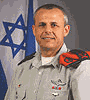
Itzhak (Gerry) Gershon, General,
the Commander of the Home Front Command
http://www1.idf.il/oref/site/en/oref.asp?pi=20008
SAYARET EGOZ:
Egoz is a Hebrew word meaning 'nut'.
Sayeret Egoz is an Israeli special forces (SF) unit.
Sayeret Egoz was formed in 1995.
When formed the unit was attached to the Golany infantry brigade, which is the IDF northern oriented infantry brigade.
A year later, in December 1996, the unit was first exposed to the public.
Like all other special units which are part of the Golany brigade, including Sayeret Golany,
Sayeret Egoz is located in the Shraga army base, north of Israel.The belonging to the Golany infantry brigade is one of great importance as it allows the unit to largely gains from Sayeret Golany vast experience and expertise in the Lebanon area.
Due to its importance and unique specialty, an attack team from the
IDF SF(Special Forces) canine unit - Oket'z - is exclusively attached to the units.. These Unit Oket'z operators sleep at the Sayeret Egoz base, accompany Sayeret Egoz teams in their missions and joint train with them frequently. The attack canine team even join Sayeret Egoz personnel in their last three months train so they will be full aware with the unit's tactics.Manpower
Although the unit was attached to Golany infantry brigade, like many other modern SF units when formed in 1995 Sayeret Egoz was built around an entire team from an exiting SF unit and from dropouts from other elite SF units. In Sayeret Egoz case, the unit was formed from an entire team from Sayeret T'zanhanim, and from Shayetet 13 and Sayeret MATKAL dropouts. This unique way of constructing a unit allows the new unit to reach an operational level in very short time, since all personnel are already highly trained SF operators and just need some additional specialized training.
Today the units personnel derive from within the Golany brigade, however the unit still receivelarge number of dropouts from other more elite SF units, primarily from Shayetet 13.
Moreover, in order to further boost up the unit's tactical ability, the unit's high-ranking officers often arrive from other elite units like Shayetet 13 and Sayeret MATKAL.
From 2002, however, a big change in due in Sayeret Egoz manpower recruitment - all personnel will not come from the inner-brigade Gibush but rather from personnel who have finished and not passed one of the IDF elite units Gibush - Shayetet 13, Sayeret Shaldag and Sayeret MATKAL, all held before the solider actual recruitment to the IDF.
Traning
Following the IDF withdrawal from South Lebanon in may 2000, and the unit involvement in the Israeli-Palestinian clashes in the Territories, the unit has much extended and modified it's training regime from 14 to 16 months.
The actual chronological order of Sayeret Egoz training regime differs from team and team but in general is consisted of:
Four months basic infantry training in the Peles army base.
Three weeks CT course held in the IDF Counter Terror Warfare School located in the Mitkan Adam army base.
Usually, the CT(Counter Terrorism) course consists of a handguns usage week.
However, since handguns aren't needed for Sayeret Egoz, the unit trains with IMI Micro Uzi instead.
Two weeks parachuting course, held in the IDF Parachuting School (MARA), Tel-Nof AFB.
Three weeks SF NCO course at the IDF Infantry School (BISLACH).
Two weeks of boulder warfare.
Four weeks of woodland warfare.
Three weeks camouflage and field craft training.
Two weeks raids training including airborne insertions.
Eight weeks navigation training.
If there is snow a one week extreme weather training in the Hermon Mountain with Unit Alpinistim.
Three weeks of summarizing training.
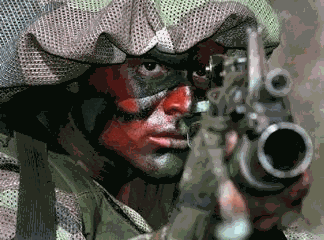
Operation Dekel (only elements of the brigade participated)
The Golani brigade
was formed on 28 February, 1948 when the Levanoni brigade deployed on Israel's Lebanese border was divided into two smaller brigades. Golani was stationed in the valleys and hills of the Lower Galilee in northern Israel. Their combatants included members of the Haganah, residents of settlements in the areas of combat, and enlisted soldiers from all over the country. Prior to the Declaration of Independence, the soldiers of the brigade fought in the areas of Mishmar Ha'emek, Tiberias, Migdal, Zemach and Rosh Pinna. Their mission was to defend the Upper Galilee and the Galilee valleys. They also participated in the victory at Safed in Operation Yiftach. They captured Arab Sejera, and Bet Shean and its environs.Upon the foundation of the State, Arab armies invaded the country. In the north, this included the Syrian army, the Iraqi army, the Lebanese army, and Kaukji's irregulars. The Golani brigade was deployed to face this threat, although it had severely depleted ranks and was short of arms. New arrivals to the State of Israel were thrown into the fray; many joined the Golani brigade. The new refugee recruits, though fiercely loyal to the country and proud of their Judaism, were reluctant soldiers. There were economic and social problems 'at home' in the transit immigrant camps. The standard of army equipment was poor. The available weapons were Czech rifles, with a builtin magazine that held only five rounds, and Sten machine guns, which were originally designed as cheap throwaways for British paratroopers to use until their 'real' weapons were dropped. As for transport, each battalion had one station wagon, a tender van, and a single truck. One company had their leave stopped by their commander because they dared respond to the battalion CO's interest in their problems by showing him boots that were tied with string to stop the soles from dropping off. However, the Golani Brigade succeeded in bringing the Syrian columns of armor and infantry to a halt, sometimes through the use of Molotov cocktails and facetoface combat. Iraqi forces were halted in the Jordan Valley. The guerilla, improvisational tactics that prevailed in the preState era were grafted with the Brigade commander's experience in the British Army to set the tone of Golani combat doctrine.
The Golani brigade took part along with the Seventh armored infantry brigade, and the Carmeli brigade in Operation Dekel (in the Galilee). In this operation, the forces involved captured the Nazareth area from Kaukji's irregulars. Golani troops, now incorporated into the newlyformed Israel Defense Forces participated in activities to gain control over the entire Galilee in what was called Operation Hiram. This involved counterthrusts that penetrated as deep as the Litani River in Lebanon.
The Golani brigade also took part in Operation Assaf to take control of the western Negev, and also participated in Operation Horev in which the Egyptians were repelled from Israeli territory. Golani's final mission in the War of Independence was the successful seizure of the Negev in Operation Ovdah. Golani participated in the capture of the Southern Negev, all the way down to the Red Sea at Eilat.
After the war, a large number of new immigrants were absorbed into the brigade, some of whom could not speak Hebrew. The newlyreorganized brigade went into action against the Syrians in 1951, after the Syrians gained control of TelMutila in the north. The Golani force involved suffered high casualties.
The next time Golani went into action was in October 1955 in coordination with the Paratrooper Brigade. Their mission was a retaliatory raid across the border from Nitzana, following recurrent Egyptian provocation.
One month later, they carried out an outstanding joint operation with the Paratroopers against outposts which threatened the Sea of Galilee region.
Israel undertook the 1956 Sinai Campaign in response to developments in the international arena. Golani's mission was to capture the Rafah area, in order to provide Israeli armored forces with a clear road into Egyptian territory.
Golani's next major activity was in 1960. Following continued Syrian harassment of farmers in the demilitarized zone in northern Israel, a Golani force attacked a Syrian outpost at Tawfiq. Two years later, they carried out another attack against the Nukeib outpost in Syria.
From 1965, the brigade was integrated into ongoing antiterrorist operations including Shune and Kilat in Jordan, and Hilweh in Lebanon.
In the Six Day War Golani troops fought in the Jordan/Syria sector. In Nablus they took part in housetohouse fighting, while on the Golan Heights the brigade was involved in heroic battles at Tel Azizyat and Tel Fahr [see below.] Elsewhere, Golani troops supported armored forces as in the capture of Zaurah and the Banias. Elements of Golani's Gideon Battalion landed by helicopter on Mt. Hermon.
Golani was now given a new role. The brigade began to reinforce outposts along the Suez Canal, patrolling the length of the new border, and pursuing terrorists into South Lebanon.
Just before hostilities broke out, Golani troops were sent to man outposts in the northern sector of the Golan Heights. When war broke out, these outposts came under attack from Syrian infantry and armor, and were subject to air strikes. Golani troops blocked possible transportation routes available to the Syrians, and then went on to take part in joint operations with IDF armored forces. After regaining territories up to the ceasefire line ("the purple line"), Golani joined Rafael Eitan's division in its thrust into the Syrian heartland.
During the early stages of the war, the Mt. Hermon outpost, known in Israel as "the eyes of the State," was captured by the Syrians. Due to the strategic importance of the outpost, high priority was placed on its recapture. Golani troops successfully undertook this difficult mission on 22 October. They suffered high casualties in this battle.
Golani at Entebbe
For years Golani was upstaged by the more glamorous, red bereted paratroopers. The Golani brown berets received recognition as an elite force in the 1976 Entebbe Operation. Golani units participated in the spectacular rescue of Israeli nationals after their plane had been hijacked to Uganda. This was not a prize for past achievement but simply acceptance that only the best would go on this mission, and Golani were the best.
In 1978, following the terrorist attack on the HaifaTel Aviv highway, the IDF launched Operation Litani. The objective of the mission was to repel terrorist organizations beyond the Litani river in Lebanon. It was an interarm action, in which a major component were the ground forces. The operation enjoyed only limited success, as the terrorist threat was not completely removed.
Continued problems with terrorist incursions from the northern border led to Operation Peace for Galilee (later known as the Lebanon War). The Golani brigade fought on the Nabatiye Heights and in Kfar Sil, but the battle for which Golani became famous in Lebanon was the capture of the Beaufort outpost a military fort dating back to the crusader period (12th century), that was used as a terrorist base.
Since the Lebanon War, Golani has continued to be a volunteer elite infantry force. They share the humdrum work of patrolling Israel's borders and facing the dangers of Lebanon together with the Paratroopers and other volunteer units.
The Golani brigade was deployed along Israel's northern borders. In the period prior to the Six Day War the Syrians built a complex system of outposts and fortifications facing the Syrians. Two positions, Tel Azizyat and Tel Fahr were part of this system. Tel Azizyat was taken by a flanking maneuver.
On 9th June, 1967 at 14:00 hours, at the same time as armored and infantry forces crossed over the "green line" (1948 ceasefire lines) a Golani's Barak battalion made their way by mechanized transport to Tel Fahr. The battle plan was to outflank Tel Fahr but the designated approach proved to be inaccessible to the force's vehicles. A new plan was therefore decided upon which required a frontal assault.
Throughout the force's approach, it suffered attacks from outposts around the route. Upon the forces' arrival at the BourjBabil Tel Fahr junction at 14:30, the battalion commander decided to assign part of his force to attacking the BourjBabil outpost, which was firing heavily upon the battalion, and preventing it from carrying out its attack effectively. Despite this, the force pressed forward, abandoning damaged and destroyed vehicles along the way.
Upon reaching the foot of the hill on which the outpost was located, the force left its vehicles to approach the outpost on foot. The force was divided into two groups, with each group attacking one of the two peaks on which the outpost was situated. Upon reaching the outer perimeter of the fortifications some soldiers flattened the barbed wire coils by lying down on the wire, thus allowing their colleagues to step on them and proceed into the fort.
The combat then moved to the trenches, where fighting was at shortrange, with very high casualties. Many soldiers, including the battalion commander, were hit by Syrian fire.
Six hours after crossing the border, a mechanized force in tracked vehicles arrived at the southern side of the outpost, and a reconnaissance group under the command of the brigade commander arrived at the northern side along with the group assigned to capture BourjBabil. Within another half an hour, Golani troops had gained control of Tel Fahr. Thirty-four soldiers fell in the battle: of these were 23 enlisted men and officers of the Barak Battalion.
Barak Battalion
Named after the biblical judge and military commander. Upon its establishment in the War of Independence, its area of activity was defined as the Sea of Galilee district, the lower Galilee and the Jordan Valley.
Gideon Battalion
Also named after a mythical judge and military commander. Upon its establishment in the War of Independence, its area of activity was defined as the Sea of Galilee district, the Ein Harod valley region and the Bet Shean valley.
The First Breachers' Battalion
Originally a battalion in the Givati Brigade, it joined the Golani brigade after the disbanding of the Givati in 1956.
"Golani Buds"
A battalion that absorbs new recruits into the brigade.
Sayeret:Sayeret (pl. sayarot) means "reconnaissance unit" in the Israel Defense Forces (IDF).
In practice, these units specialize in commando and other special forces roles, in addition to reconnaissance (the degree of specialization varies by units and current needs). Such units are usually a company or a battalion in strength.
Combat brigades in the IDF usually have a company with improved weaponry, also known as plugat siyur ( pl. plugot siyur, abbr: palsar ), that is used to reinforce the brigade's regular forces. Other sayarot are larger units, operating under corps and commands. Although the plugot siyur are mostly oriented at battlefield support (which is their raison d'être), many have participated in special operations during recent years. All infantry units as well as the 7th Armoured Brigade have plugot siyur.
Each of the four Infantry Brigades (Golani, Givati, Nahal and Paratroopers) has its own Special Forces reconnaissance battalion (Yehidat Siyur, abbr: Yahsar). This battalion is made up of three specialized company-size units: Demolitions (Plugat Heil Handasa, abbr: Palhan), Recon (Palsar, mentioned above) and Anti-Tank (Plugat Neged Tankim, abbr: Palnat). While in the past there were differences between the three units, the IDF is now consolidating the three specialized units into one larger battalion-size unit with many different capabilities. This is part of the Yatah Project or, as it is called in English, the Low-Intensity Combat Unit project. This project aims at changing the Reconnaissance battalions into specialized urban counter terror units, that are specifically trained and equipt to operate in current combat situations.
In addition to the brigade sayeret units, IDF combat divisions have their own battalion-size recon units (Gdud Siyur, abbr: Gadsar).
There are also several battalion-size special forces units which report directly to regional, functional (navy/air-force) and the general commands. The best known of these are Sayeret Matkal and Shayetet 13.
List of known sayeret units:Sayeret Matkal is a special operations unit under the IDF General Command. It is a designated deep reconnaissance unit but it also has counter-terrorist responsibilites. The unit is modelled on the British Special Air Service. It is best known for Operation Entebbe, in which they rescued more than 100 Air France airline passengers hijacked to Uganda by PLO terrorists.
Sayeret Yahalom (formerly Sayeret Yael) is a special elite combat engineering unit of the Engineering Corps. It is specialized in accurate demolitions and planting pinpoint explosives.
Shayetet 13 is the Israeli naval commando.
Other sayarot that became public over the years:
Sayeret Egoz - Northern Command
Sayeret Haruv - Central Command
Sayeret Shaked - Southern Command
Sayeret Shaldag (aka Unit 5101) - Israeli Air Force
Sayeret Shimshon - Gaza Strip between 1985-1995
Yahsar Nahal - West Bank
Yahsar Tzanchanim - West Bank
Yahsar Golani - Gaza Strip
Yahsar Givaty - Gaza Strip

Shabak emblem
"Defender who shall not be seen"
The Shabak ("Shabak" an acronym of ) known in English as the Shin Bet (which was how the Shabak was known
in Israel in its early days) or the GSS (General Security Service), is the Internal General Security Service of Israel. Its motto is whose translation is: "Defender (Shield) who shall not be seen". The service consists of close to 5,000 employees.1 Duties and roles
2 Legal status and methods
3 History
3.1 Foundation
3.2 Early days
3.3 After the Six Day War
3.4 Years of crisis
3.5 During the al-Aqsa Intifada
3.6 Current events
3.7 Rising Profile
4 Criticism
5 Lists and tables
5.1 Important events in Shabak history
5.2 Heads of the Shabak
Duties and roles
The Shabak duties are:
Upholding the state security against those who seek to undermine it by terrorist activity or violent revolution.
Expose terrorist organizations of Israeli civilians (both Jewish and Arab).
Interrogations of terror suspects.
Providing intelligence for counter-terrorism operations in the West Bank and the Gaza Strip.
Counter-espionage.
Protect the lives of senior public officials (see also: bodyguards).
Secure important infrastructure and government buildings.
Ensure the security of El-Al, Arkia and Israir flights and Israel's embassies abroad.
One of the Shin Bet's roles is to protect the lives of senior Israeli ministers and public servants (such as the President of Israel). The Shin Bet is also responsible for preventing the funding of underground movements and terror groups whose members are Israeli citizens. It accomplishes this goal by using interrogations and secret agents (HUMINT).
Legal status and methods
The Shabak relies mainly on HUMINT to extract information and gather intelligence. It uses informants from the local population in order to gather intelligence about planned terror attacks or about the location of terror leaders. Shabak had overwhelming success with informants, managing to target the top leaders of the Palestinian terror organizations - including hardliners such as Hamas and the Islamic Jihad. The killing of Sheikh Ahmed Yassin and Abed al-Aziz Rantissi shows how deeply Shabak has penetrated into the Palestinian militias. As a result, the Palestinians groups, mainly the al-Aqsa Martyrs' Brigades started lynching suspected collaborators and killing them on the street without a trial.
Shabak also extracts information by interrogating suspects. In 1987, after complaints about excessive use of violence in interrogations of Palestinian prisoners, the Landau Committee (headed by a former Supreme Court President) prepared a two-part report on Shabak's interrogation methods. Only one part was made public. It revealed that the Shabak regularly used violent methods of interrogation and that Shabak agents were tutored to lie in court about how evidence was uncovered. The committee report also gave guidelines for future interrogations but most of the details were in the secret part of the report. The open part revealed that the guidelines allowed Shabak to apply "moderate physical pressure" in the case of "necessity". In 1994, State Comptroller Miriam Ben-Porat, in a report not made public until February 2000, found that during 1988-1992 "Violation of the Landau Commission and the GSS regulations continued to be widespread in the interrogation facility in Gaza and, to some extent, in other facilities. ... Veteran and senior investigators in the Gaza facility carried out severe and systematic violations. Senior GSS commanders did not prevent these violations."In 1999 the Israeli Supreme Court heard several petitions against Shabak methods. It found that these included: (1) "forceful and repeated shaking of the suspect’s upper torso, in a manner which causes the neck and head to swing rapidly", (2) manacling of the suspect in a painful "Shabach position" for a long period of time, (3) the "frog crouch" consisting of "consecutive, periodical crouches on the tips of one’s toes", and other methods. The Court ruled that Shabak did not have the authority, even under the defense of "necessity", to employ such methods.
In the Justice Ministry, the Department For Special Roles, there is a senior investigator who checks complaints about Shabak interrogations. Shabak claims that it is now basing its interrogations only on psychological means. However, organizations such as B'Tselem and Amnesty International still regularly accuse Shabak of employing physical methods that amount to torture according to international conventions.
In 2002 the Israeli Knesset passed a law, regulating the activity of Shabak. The law ruled that:
The Prime Minister of Israel is in charge of the Shabak and carries ministerial responsibility for its activity. The head of the Shabak answer to the prime minister.
The Shabak head will serve 5 years in duty, unless there is a state of emergency.
Interrogation methods: this part was not made public.
History
Foundation
With the declaration of Israeli Independence, the Shin Bet was founded, as a branch of the Israel Defense Forces, and was headed by Isser Harel (the father of Israeli Intelligence, who later headed the Mossad). Responsibility for Shin Bet activity was later moved from the IDF to the office of the prime minister. During the 1948 Arab-Israeli war that was declared against Israel following the Israeli independence, the Shin Bet's responsibility included only internal security affairs. It was only later that its responsibilities were extended to Counter-espionage and the monitoring of Israeli Arabs (Arabs who were not forced off their land after the 1948 war of Israeli independence and who were granted Israeli citizenship).
Early days
In the beginning, as part of the efforts to prevent undermining activity, the Shin Bet also monitored pro-Soviet opposition parties, which were suspected of supporting the Soviet Union over Israel if the Cold War would become an active full scale war. Today, this kind of activity is considered harmful to democracy. The political leadership, headed by David Ben-Gurion, made sure to silence publications that dealt with those activities, which were published only in Haolam Hazeh newspaper by Uri Avneri. A great controversy was created, when two Shin Bet agents were caught installing a bugging device in Meir Yeari's office (Yeari was the leader of Mapam - a Socialist Zionist party, but with favorable reviews on the Soviet Union and Joseph Stalin).
Up until the Six Day War, the Shin Bet continued to focus on counter-espionage and monitoring political activity among the Israeli Arabs. Shabak's most notable achievement in counter-espionage was the capture of Dr Israel Bar in 1961 who was revealed to be a Soviet spy. Bar was a Lieutenant Colonel in the reserves, a senior security commentator and close friend of Ben-Gurion, and reached high Israeli circles. Bar was tried and sentence to life in prison, where he died. In the same year, Kurt Sita, a Christian German from the Sudets and a professor in the Technion, was revealed as a Czech spy.
After the Six Day War
After the Six Day War, Shabak efforts to monitor terrorist activity in the West Bank and Gaza Strip become a more and more dominant part of the organization activity, and today it is considered to be the major part of Shabak's mission. Yeshayahu Leibowitz warned that the control over the territories will turn Israel into a "Shabak state". However, Shabak imposed restrictions on itself in order to not harm democratic values, separation of authorities and to prevent the risk that Shabak will be used in a totalitarian manner.
Years of crisis
During 1984-1986 Shabak went into a major crisis following the Kav 300 affair in which two terrorists who hijacked a bus and took hostages were executed without trial by Shabak officers, who later covered up the event and gave false testimonies. Following this affair, Avraam Shalom (then the head of Shabak) was forced to resign.
The event resulted in the Landau committee, which regulated Shabak interrogation methods.
In 1995 a crisis followed the assassination of Israeli Prime Minister Itzhak Rabin by Yigal Amir. Following the Shabak's failure to protect Rabin, Carmi Gillon was forced to resign. Later, the Shamgar investigation committee learned of serious flaws in the personal security unit and the provocative and inciting behavior of Avishay Raviv - an Agent provocateur of the Shin Bet Jewish Unit. Raviv obtained a "photoshopped" picture of Rabin in an SS uniform, created by two Chabadniks, and presented it in the infamous Zion Square demonstration in Jerusalem prior to Rabin's murder.
Gillon was replaced by outside "import", Israeli Navy admiral Ami Ayalon. Ayalon rehabilitated Shabak after Rabin's murder and worked hard to restore its reputation with the general public.
In 1996, a unit of the Shabak assassinated Hamas chief bombmaker Yahya Ayyash by planting an explosive device in his cellular phone. The operation was carried out after an instruction by then Prime Minister Shimon Peres.
During the al-Aqsa IntifadaIn 2002, Ayalon ended his 5-years term and he was replaced by veteran Shabak official, Avi Dichter. Dichter, an ex-Sayeret Matkal commando
and an experienced Shabak agent, restored Shabak's good reputation and tightened the working relationship with the Israeli Defence Forces and the Israeli police. Foreign press hinted that Shabak is working tightly with the elite Israeli counter-terror unit, YAMAM.Dichter was in charge when the al-Aqsa Intifada erupted. He managed to react quickly to changes and turn Shabak into a prominent player in Israel's war against terror-inciting Palestinians after the collapse of the 2000 Camp David Summit.
The Shin Bet is most known for its role in the conflict with Palestinians. The Shin Bet produces intelligence which enables the Israeli Defence Forces (IDF) to prevent suicide bombings before they reach their destinations. This is usually done by preventive arrests and deploying road blocks when there is a serious alert.
In addition to preventing suicide bombings from the West Bank by arrests and special operations, Shabak is working tightly with the Israeli Air Force in order to pinpoint and kill terror masterminds and terrorist leaders by precision air strike. The targets are field commanders and senior leaders of Palestinian militant factions (which Israel consider as terrorists), mainly those of Hamas, but also of the Islamic Jihad, the Al-Aqsa Martyrs Brigades, the Fatah and even one Al-Qaeda linkman (Iad Al-Bik). These assassinations, called "targeted killings", are usually done by helicopter gunships, where both IAF commanders and Shabak agents sit together in the command center monitoring the operation. Shabak's task is giving intelligence when and where the target will be available for a strike and then reacting to IAF drone feedback and ensuring the men on the sight are indeed the wanted terrorists (this part is called "identification and incrimination").
Shabak's effective activity during the second Intifada boosted its reputation both among the Israeli public and counter-terror experts.
Current events
In November 2003, four former heads of Shin Bet (Avraham Shalom, Yaakov Peri, Carmi Gillon and Ami Ayalon) called upon the Government of Israel to reach a peace agreement with the Palestinians.
Ami Ayalon, along with Palestinian professor Sari Nusseibeh, launched the National Census peace initiative.
Avi Dichter is one of the chief supporters of building a defence barrier against Palestinians in the West Bank. The Israeli government began building the Israeli West Bank Barrier in 2003. Dichter has since said that the barrier 'is working' and helps to prevent and reduce terror attacks.
In February 2005, Ariel Sharon announced that Yuval Diskin, a veteran Shabak field agent, senior negotiator with Palestinian officers and mastermind of the "targeted killings", will replace Dichter after he ends his five-year term. On May 15, 2005 Diskin entered into office after Dichter left with great applause from the press, the politicians, and the public.
Rising Profile
Once considered a commitment to lifelong anonimity and even invisilibility in Israeli society, today a Shabak agent who achieves high rank in the service, especially the director, is considered a candidate for membership in the top brass of the Israeli government and business community. This process follows a trend started by ex-generals and colonels of the Israel Defense Forces, the trailblazers including Moshe Dayan, Ariel Sharon, and Yitzhak Rabin. In the Shabak and the foreign intelligence Mossad service, the trend showed up much later, even though Isser Harel (who served as head of both services) and Meir Amit of the Mossad both served as lawmakers.
Ex-Shabak directors today are increasingly visible as candidates for higher office. Yaakov Peri became the chairman of Bank HaMizrahi in 2002, and also became a highly visible guest on television programs. Carmi Gillon serves as mayor of Mevasseret Zion near Jerusalem, while Avi Dichter and Ami Ayalon are currently leading candidates for defense minister. Ayalon has attracted widespread following as a co-initiator with Palestinian dignitary Sari Nusseibeh of the non-governmental Peoples' Voice initiative to petition the governments in Israel and the Palestinian Authority for a permanent settlement.
CriticismThe "Shabak technique" is an extreme interrogation technique used by the Shin Bet, also known as the General Security Service or SHABAK on Palestinian suspects.
It has never officially been confirmed by the highly secretive Shin Bet as accepted use. Informal accounts indicate it may involve forcing the subject to sit on a short stool or chair which is angled forward (so it's impossible to sit in a comfortable, stable position), and then tying their arms and legs behind them to the chair, while also covering their head with a bag and possibly subjecting them to extremely loud noise, such as music. The subject is then left in this condition for extended periods of time. Sleep is not allowed for the duration. If this does in fact occur, it may be torture and therefore illegal under international law.Lists and tables
Important events in Shabak history
1948: the Shabak is funded as a Shin Bet and is one of the three secret services in Israel along with the Military Intelligence and the Foreign Intelligence (later, the Mossad).
1961: the Shabak expose Doctor Israel Bar as a Soviet spy.
1984: the Kav 300 Affair, two terrorists hijacked a bus and after IDF SF and Shabak regained control over the bus, Avraam Shalom ordered the killing of the two terrorists who were captured alive. The officers involved tried to cover this up.
1987: the Izat Nafsu affair, when an officer was cleared from spy charges, and Shabak was highly criticized for his methods and norms.
1995: the assassination of Itzhak Rabin by Yigal Amir and the failure of Shabak to prevent it.
1996: the Shabak assassinates Hamas top bombmaker Yahya Ayyash.
2000-2005: the al-Aqsa Intifada and Shabak main role in intelligence gathering and counter terror efforts. Avraam Dichter received high credit for Shabak part in thwarting hundreds of suicide bombings and the targeted killing of terrorist leaders.
Heads of the Shabak:Isser Harel (1948–1952)
Izi Dorot (1952–1953)
Amos Manor (1953–1963)
Yossef Harmelin (1964–1974)
Avraam Ahitov (1974–1981)
Avraam Shalom (1981–1986)
Yossef Harmelin (1986–1988)
Yaakov Peri (1988–1994)
Carmi Gillon (1995–1996)
Ami Ayalon (1996–2000)
Avi Dichter (2000–2005)
Yuval Diskin (2005–)YAMAM:

YAMAM symbol
The YAMAM, is the acronym for Special Police Unit in Hebrew, Israel's elite civilian counter-terrorism unit. The YAMAM has a world-wide reputation as a professional and successful counter terrorism unit and it is capable of both hostage-rescue operations and offensive take-over raids (for use against terrorists). Besides counter-terrorism duties, it also performs SWAT duties and undercover police work.
Contents |
YAMAM stands for Special Police Unit .
In Israel it is also called "Unit for Counter-Terror .
The YAMAM answers to the MAGAV central command and belongs to the civilian Israeli police forces rather than the military. Its operators and officers are professional policemen on payroll, usually with combat experience from their military service within the IDF.
The YAMAM is self-dependent, training its own operators in all fields, such as sniping, recon, dog operating, bomb disposal, etc. As a result, the YAMAM has a very rapid deployment time and high coordination between various squads (sniping squad, entry team, engagement force, etc.).
The YAMAM's primary duties are:
Hostage rescue (terrorist events).
Hostage rescue (criminal events).
Counter terrorism (preventative operations).
SWAT duties - handling dangerous criminals.
Undercover police operations.
VIP security.
Most of the YAMAM's activity is classified, and published YAMAM operations are often credited to other units. Nevertheless, the YAMAM enjoys a high reputation among SF professionals and the Israeli public.
HistoryThe YAMAM was established after the Maalot massacre, where a failed operation by military special forces units ended with 21 children murdered before the terrorists were killed. Since hostage rescue in friendly territory is different from counter-terrorism in hostile areas, it was decided to establish an elite civilian force, which develops and practices a special CQB (Close Quarters Battles) doctrine for counter-terrorism operations in friendly territory and hostage rescue. In the late 1974 the YAMAM was established as and falls under the direct jurisidiction of a special forces counter-terrorism unit of the MAGAV — the combat arm of the police.
The YAMAM has carried out many counter-terror operations.
Some of the missions known to the public prior to the al-Aqsa Intifada are listed below:
In March, 1988, the YAMAM was called into action after a group of three Palestinian terrorists hijacked a bus full of women near Dimona, in an incident known as the "Mothers Bus". The YAMAM performed a rescue operation, killing all three terrorists, but didn't manage to prevent three Israeli passengers from being killed.
On March 3, 2000, the YAMAM captured a terrorist group hidden in the Israeli-Arab town of Taibe with the aid of Sayeret Duvdevan and an IDF Caterpillar D9 bulldozer. In the end of the raid, one terrorist was arrested and four were killed. [1]
The YAMAM has carried out many counter-terror operations during the Al-Aqsa Intifada within the last few years. The vast majority of them are classified. Some of the most notable are listed below:
April 7, 2002: A combination of SHABAK, the YAMAM and the IDF leads to the capture of Case Aduwan, a Hamas terrorist who planned the Passover massacre in Netanya. Aduwan fortified himself in a house along with four armed terrorists. During the raid, YAMAM snipers killed two terrorists and IDF forces detonated a car bomb meant to be sent into an Israeli city. After 12 hours of heavy fire exchanges, an armoured IDF Caterpillar D9 demolished the house. Aduwan's body was found under the rubble.
YAMAM and Sayeret Matkal rescued Israeli cab driver Eliyaho Goral, after he was kidnapped by Palestinian militants.
June 23, 2003: YAMAM forces killed Hamas's head in Hebron, Abbedullah Qawasameh.
December 3, 2003: YAMAM forces foiled an attempted massacre in Yokne'am school by Palestinian terrorists.
YAMAM forces killed Sirhan Sirhan, a Palestinian terrorist who was responsible for the slaughter of a mother and her two children in Kibbutz Metzer.
YAMAM forces, together with IDF elite units, arrested 12 al-Aqsa Martyrs' Brigades terrorists, which used the shelter of a mental institute in Bethlehem to prepare a huge suicide bombing against Israel during Passover.
July 25, 2004: YAMAM forces kill 6 Tanzim terrorists in Tulkarm, including the local head and a linkman to Hizbullah.
November 21, 2004: Three Fatah militants were killed in a gunfight with the YAMAM. One of the dead was Mohammed Rassan Sheikh, a senior Fatah militant who hid in Arafat's compound for a long time. (Haaretz)
Asaf Hafetz (1974-1988)
Elik Ron (1988-1992)
David Tzur (1992-1995)
Israeli Oppression Machinery
February 2006