September 2006
Hazard of New Fortunes
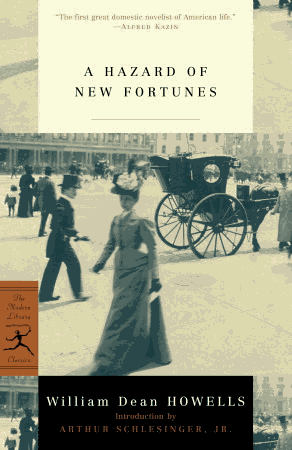
A Hazard of New Fortunes by William Dean Howells
A Hazard of New Fortunes is a novel by William Dean Howells.
First published in 1890, the book was well-received for its awareness of social injustice—indeed, the book, considered by many to be his best work, was one of three Howells had written with Socialist and Utopian ideals in mind; The Quality of Mercy in 1892, and An Imperative Duty in 1893.
The book, which takes place in 19th Century New York, tells the story of the dispute between a self-made millionaire and a social revolutionary, with a third man attempting to act as mediator, yet his efforts prove futile.
Centering on a conflict between a self-made millionaire and an idealistic reformer in turn-of-the-twentieth-century New York,
A Hazard of New Fortunes insightfully renders the complexities of the American experience at a time of great social and economic upheaval and transformation. In its depiction of wealth, poverty, and New York City life, it remains a strikingly contemporary work.Editorial Reviews
Review
The first great domestic novelist of American life.
-Alfred Kazin --This text refers to the Paperback
edition.
Book Description
"A great American novel . . . it remains uncannily contemporary."
(Adam Gopnik, The New Yorker)
Set against a vividly depicted background of fin de siécle New York, this novel centers
on the conflict between a self-made millionaire and a fervent social revolutionary-a
conflict in which a man of goodwill futilely attempts to act as a mediator, only to be
forced himself into a crisis of conscience. Here we see William Dean Howells's grasp of
the realities of the American experience in an age of emerging social struggle. His
absolute determination to fairly represent every point of view is evident throughout this
multifaceted work.
Both a memorable portrait of an era and a profoundly moving study of human relationships, A Hazard of New Fortunes fully justifies Alfred Kazin's ranking of Howells as "the first great domestic novelist of American life."
Product Details:
Paperback: 480 pages
Publisher: Penguin Classics; New Ed edition (November 27, 2001)
ISBN: 0140439234
William Dean Howells
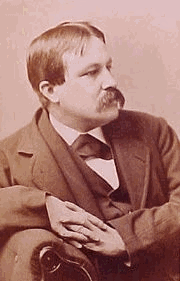
(March 1, 1837 – May 11, 1920)
William Dean Howells (March 1, 1837 – May 11, 1920)
was an American realist author and literary critic.
Born in Martins Ferry, Ohio, originally Martinsville, to William Cooper and Mary Dean Howells, Howells was the second of eight children. His father was a newspaper editor and printer, and the father moved frequently around Ohio. Howells began to help his father with typesetting and printing work at an early age. In 1852, his father arranged to have one of Howells' poems published in the Ohio State Journal without telling him.
In 1856, Howells was elected as a Clerk in the State House of Representatives. In 1858, he began to work at the Ohio State Journal where he wrote poetry, short stories, and also translated pieces from French, Spanish, and German. He avidly studied German and other languages and was greatly interested in Heinrich Heine. In 1860, he visited Boston and met with American writers J. T. Fields, James Russell Lowell, Oliver Wendell Holmes, Nathaniel Hawthorne, Henry David Thoreau, and Ralph Waldo Emerson
Said to be rewarded for a biography of Abraham Lincoln used during the election of 1860, he gained a consulship in Venice. On Christmas Eve 1862, he married his wife Elinor Mead at the American embassy in Paris. Upon returning to the U.S., he wrote for various magazines, including Atlantic Monthly and Harper's Magazine. From 1866, he became an assistant editor for the Atlantic Monthly and was made editor in 1871, remaining in the position until 1881. In 1869, he first met Mark Twain, which sparked a longtime friendship. Even more important for the development of his literary style--his advocacy of Realism--was his relationship with the journalist Jonathan Baxter Harrison, who in the 1870s wrote a series of articles for the Atlantic Monthly on the lives of ordinary Americans (Fryckstedt 1958).
He wrote his first novel, The Wedding Journey, in 1872, but his literary reputation took off with the realist novel, A Modern Instance, published in 1882, which described the decay of a marriage. His 1885 novel The Rise of Silas Lapham is perhaps his best known, describing the rise and fall of an American entrepreneur in the paint business. His social views were also strongly reflected in the novels Annie Kilburn (1888) and A Hazard of New Fortunes (1890). He was particularly outraged by the trials resulting from the Haymarket Riot.
Howells also wrote plays, criticism, and essays about contemporary literary figures such as Henrik Ibsen, Émile Zola, Giovanni Verga, Benito Pérez Galdós, and, especially, Leo Tolstoy, which helped establish their reputations in the United States. He also wrote critically in support of American writers Hamlin Garland, Stephen Crane, Emily Dickinson, Mary E. Wilkins Freeman, Paul Laurence Dunbar, Sarah Orne Jewett, Charles W. Chesnutt, Abraham Cahan, and Frank Norris. It is perhaps in this role that he had his greatest influence. In his "Editor's Study" column at the Atlantic Monthly and, later, at Harper's, he formulated and disseminated his theories of "realism" in literature.
In 1904, he was one of the first seven chosen for membership in the American Academy of Arts and Letters, of which he became president. In 1928, eight years after Howells' death, his daughter published his correspondence as a biography of his literary years.
A Hazard of New Fortunes is a novel by William Dean Howells.
Their Wedding Journey
A Chance Acquaintance
A Foregone Conclusion
The Rise of Silas Lapham, 1885
The Shadow of a Dream
The Day of Their Wedding
A Traveller from Altruria
The Whole Family: a Novel by Twelve Authors
A Counterfeit Presentment
The Lady of the Aroostook
The Undiscovered Country
A Fearful Responsibility
Dr. Breen's Practice
A Woman's Reason
Three Villages
Tuscan Cities
The Minister's Charge
Indian Summer
Modern Italian Poets
April Hopes
Criticism and Fiction
The World of Chance
The Coast of Bohemia
The Story of a Play
Ragged Lady
Their Silver Wedding Anniversary
The Flight of Pony Baker
The Kentons
Son of Royal Langbrith
London Films
Certain Delightful English Towns
Between the Dark and the Daylight
Heroines of Fiction
My Mark Twain
New Leaf Mills
Seen and Unseen at Stratford-on-Avon
His poems were collected in 1873 and 1886, and a volume under the title Stops of Various Quills appeared in 1895.
He was the founder of the school of American realists who derived through the Russians from Balzac and had little sympathy with any other form of fiction, although he was full of encouragement for new writers in whom he discovered a fresh note. It can hardly be doubted that his was the most influential work done in American fiction during the last quarter of the nineteenth century.
Fryckstedt, Olov W. 1958. In Quest of America:
A Study of Howells’ Early Development as a Novelist. Upsala, Sweden: Thesis.
This article incorporates text from an edition of the
New International Encyclopedia that is in the public domain.
has a collection of quotations related to: William Dean Howells
Works by William Dean Howells at Project Gutenberg
William Dean Howells Society includes a biographical sketch of Howells, links to his works (including the "Editor's Study" columns), questions and replies, bibliographies, and pictures.
Realism in American Literature at the Literary Movements site
Retrieved from "http://en.wikipedia.org/wiki/William_Dean_Howells"
A Hazard of New Fortunes William Dean Howells novel
September 3, 2006