July 2006
Islam-Bashing Prof. Karsh
By Efraim Karsh
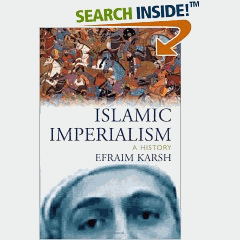
Yale. 276 pp. $30
It sounds like yesterday's newspaper:
Growing lawlessness... led to the formation of citizen organizations for defense and reprisals... . Notable among these were... thugs drawn from the lower reaches of society... .
Ready to sell their services to the highest bidder, groups... competed against each other to serve the rival Shiite and Sunni camps in their incessant squabbles...
Yesterday's Financial Times on today's Iraq?
No, Efraim Karsh on eighth-century Baghdad.
Forgive yourself if "the more things change, the more they stay the same" comes to mind.
Muslim scholars, proud of Islam's cultural feats, often don't know what to say about its endemic violence and militarism. Even great ones fall victim to soft-pedaling the endless battles, assassinations and massacres by which Islam expanded from Arabia to become a world religion. In his Islam: Religion, History, and Civilization (2003), the distinguished Iranian philosopher S.H. Nasr embodied this tradition in a telling, self-contradictory sentence:
"In less than a century after the establishment of the first Islamic society in Medina by the Prophet, Arab armies had conquered a land stretching from the Indus River to France and brought with them Islam, which, contrary to popular Western conceptions, was not forced upon the people by the sword."
You might say that Efraim Karsh, head of the Mediterranean Studies Program at the University of London, gives the other side of the story.
In his nervy, tightly documented Islamic Imperialism, Karsh challenges scholars and Muslim leaders to refute his own picture of Islam: an imperialist seventh-century Arabic movement that forced itself on neighboring lands such as today's Pakistan, Iran, Iraq, Syria and Egypt for secular colonialist payoffs - money, booty, territory.
According to Karsh, Muhammad, by claiming Allah's authority to act as both a political and religious leader, was able "to cloak his political ambitions with a religious aura" and "channel Islam's energies" into geographic expansion.
In seventh-century Arabia, Karsh argues, the peninsula teemed with people claiming divine inspiration. What Muhammad added, Karsh contends, was insistence on Allah as the sole god, a desire to unite believers equally in a Muslim umma (or "community of believers"), and a will to do so by force if persuasion failed.
On the practical side, Karsh maintains, Islam began in banditry. After going to Medina, Muhammad sought to "entice his local followers into raiding the Meccan caravans," and the multiple attacks increased their war chests. His unpopularity with Meccans stemmed not just from his new beliefs, Karsh asserts, but from his brigandage.
Medina, originally known as Yathrib, had been partly "settled by Jewish refugees fleeing Roman persecution." Karsh says Muhammad first tried to persuade Yathrib's three Jewish tribes - the Quainuqa, Nadir and Quraiza - to convert to Islam. He adopted "a number of Jewish rituals," including praying "toward Jerusalem" and not eating pork.
When the "Medina Jews" demurred, Karsh states, Muhammad turned on them, dropping Jewish rituals and changing the direction of prayer to Mecca.
Eventually, Karsh writes, Muhammad expelled the Quainuqa and Nadir and stole their goods. Then, in 627, after accusing the Quraiza of conspiring with Meccan enemies, Muhammad ordered its nearly 800 men beheaded. The Muslims sold the women and children into slavery and split the tribe's money.
Muhammad also continued his conquest of Arabia. He conducted raids throughout the peninsula and "resorted to the assassination of political rivals." In 630, he showed up at Mecca with an army, the city capitulated, and Islam's great rise began.
In Karsh's view, Muhammad has served as a model for Muslims not just as a wise man and prophet, but as a warrior.
Anyone not expert on early Islam will need a scorecard to follow the innumerable murders, impalings, decapitations and dismemberments that marked the early Islamic caliphates and Shiite/Sunni split.
You think what's happening in Iraq is new? So many severed heads get sent from one leader to another in Islamic Imperialism, you wonder why
"Fed Head" didn't get off the ground as a Meccan firm.
From Muhammad's farewell address in 632 ("I was ordered to fight all men until they say, 'There is no God but Allah.' "), to Saladin in 1189 ("I shall... pursue them until there remains no one... who does not acknowledge Allah"), to Osama bin Laden in 2001 ("I was ordered to fight the people until they say there is no god but Allah..."), Karsh finds Islam's outward imperialism consistent.
But internally, Karsh notes, mayhem against rival Muslims also implicated Islam's spiritual side as "a facade that concealed what was effectively a secular and increasingly absolutist rule," one by which Arab caliphs could "enjoy the material fruits of imperial expansion."
Every Islamic takeover, Karsh emphasizes, came with a demand for tribute, taxes, or both: "Arab conquerors were far less interested in the mass conversion of the vanquished peoples than in securing their tribute." Meanwhile, infighting made "a mockery" of Muhammad's ban on fighting among Muslims.
This history of Islam's internal wars forms the timely, eye-opening side of Karsh's book. By the first Abbasid caliphate in 749, Karsh summarizes, "the Islamic empire was an Arab military autocracy run by Arabs for the sole benefit of Arabs."
Islamic Imperialism stirs a thought beyond its historical record. American newspapers have lately flagellated themselves for not challenging the White House's belief that Iraq possessed WMDs.
Karsh's history suggests a different foul-up: their editorial drumbeat for the United States to immediately return sovereignty to Iraq, as if an artificial nation containing two Islamic factions long at each other's throats, their ethics further deadened by dictatorship, could handle democracy without any re-education or experience.
For all the analogies early in the Iraq War to our post-World-War-II rebuilding of Germany and Japan, Karsh's history, which takes Islam right through the Ottomans and Osama, indicates that both the White House and press ignored a crucial historical truth: Cultures rooted in violence, if not shown another way of life before being given back a right of self-determination, slip back into it.
Editorial Reviews:From Booklist
Middle East scholar Karsh surveys for a
general audience the region's Islamic political past. Parallel to his narrative, Karsh
frequently contrasts the universalistic proclamations of Islam with cycles of imperial
consolidation and fragmentation. After recounting the Prophet Muhammad's religio-political
establishment of Islam, and the discord about his legacy that continues today, Karsh
narrates the battles over Muhammad's caliphate that eventuated in the Umayyad and Abbasid
Empires. Karsh's commentary often looks forward to contemporary ideologues of Islam who
ransack history to justify grievances. In Karsh's coverage, the irruption of the Crusaders
into the Levant hardly provoked a jihad to eject them; that occurred, in his account,
through politically ordinary processes of empire building, eventually by the celebrated
Saladin. Islamic unity and zeal, however, had always to be affirmed by reestablishers of
the caliphate, a theme Karsh incorporates into his chronicling of the rise and decline of
the Ottoman Empire, the distribution of its territories after World War I, and varieties
of pan-Arabism prevalent after World War II. An informative foundation for further
exploration of Islamic history.
From the first Arab-Islamic Empire of the mid-seventh century to the
Ottomans, the last great Muslim empire, the story of the Middle East has been the story of
the rise and fall of universal empires and, no less important, of imperialist dreams. So
argues Efraim Karsh in this highly provocative book. Rejecting the conventional Western
interpretation of Middle Eastern history as an offshoot of global power politics, Karsh
contends that the region’s experience is the culmination of long-existing indigenous
trends, passions, and patterns of behavior, and that foremost among these is Islam’s
millenarian imperial tradition.
The author explores the history of Islam’s imperialism and the persistence of the
Ottoman imperialist dream that outlasted World War I to haunt Islamic and Middle Eastern
politics to the present day. September 11 can be seen as simply the latest expression of
this dream, and such attacks have little to do with U.S. international behavior or policy
in the Middle East, says Karsh. The House of Islam’s war for world mastery is
traditional, indeed venerable, and it is a quest that is far from over.
Product Details:
Hardcover: 288 pages
Publisher: Yale University Press April 26, 2006
ISBN: 0300106033
Prof. Karsh & the Rise of the Zionist Academic Islam-bashers
July 25, 2006