
April 2006
Lawrence Livermore Science

IN
studying Earth’s carbon cycle—the exchange of carbon between the planet’s land, atmosphere, and oceans—scientists are trying to understand the role played by huge tropical rainforests such as the Amazon River basin. In particular, they want to determine how long an ecosystem stores atmospheric carbon dioxide in its plants, soils, and rivers. Many scientists hope that such
ecosystems might sequester this greenhouse gas, produced in excess by human activities,
for decades or even centuries. However, results from a collaboration involving researchers
from the University of Washington (UW), the Stroud Water Research Center, Livermore’s
Center for Accelerator Mass Spectrometry (CAMS and the University of São Paulo, Brazil,
indicate that carbon cycling in the Amazon River basin may be much faster than predicted.
Measurements of river water samples showed that the carbon had been stored in the
surrounding landscape of the 6.2-million-square-kilometer basin for only about 5 years
before being returned to the atmosphere as carbon dioxide.),
Many scientists hope that such
ecosystems might sequester this greenhouse gas, produced in excess by human activities,
for decades or even centuries. However, results from a collaboration involving researchers
from the University of Washington (UW), the Stroud Water Research Center, Livermore’s
Center for Accelerator Mass Spectrometry (CAMS and the University of São Paulo, Brazil,
indicate that carbon cycling in the Amazon River basin may be much faster than predicted.
Measurements of river water samples showed that the carbon had been stored in the
surrounding landscape of the 6.2-million-square-kilometer basin for only about 5 years
before being returned to the atmosphere as carbon dioxide.),

In Earth’s carbon cycle, carbon is exchanged between the planet’s land, atmosphere, and oceans. In the process, it is transformed from inorganic carbon to organic carbon and back again.
Carbon Goes Full Circle in the Amazon
Recent measurements indicate that the Amazon River basin returns carbon to the atmosphere
in only 5 years.
In Earth’s carbon cycle, carbon is exchanged between the planet’s land, atmosphere, and oceans. In the process, it is transformed from inorganic carbon to organic carbon and back again.
Key Words:
Amazon River basin, carbon-14, carbon cycle, carbon dioxide,
Center for Accelerator Mass Spectrometry (CAMS), radiocarbon dating, sequestration.
For further information contact Tom Brown (925) 423-8507 (
brown92@llnl.gov).What Goes around Comes Around
The term
carbon cycle describes the complex processes carbon undergoes as it is transformed from organic carbon—the form found in living organisms such as plants and trees—to inorganic carbon and back again. Most of the carbon in rivers originates as atmospheric carbon dioxide and either cycles back to the atmosphere or settles in sediments of the coastal ocean where it is eventually buried.For example, in the Amazon basin,
tropical forests "breathe in" carbon dioxide from the atmosphere and during
photosynthesis transform this inorganic carbon into organic carbon.
As plants die and decay, they carry carbon into the soil. Decomposition then begins to
transform organic carbon back again into inorganic carbon. Rain and groundwater transport
carbon from soil, decomposing woody debris, leaf litter, and other organic matter in the
waterways, where it is digested by microorganisms, insects, and fish. The carbon dioxide
they generate and the dissolved inorganic carbon carried into the rivers from on land then
return to the atmosphere.Determining the sources of carbon in a
river, how long it was on land, and when it changed forms are difficult problems because
so many plants and soils contribute to the carbon cycle. Previous measurements in the
downstream section of the Amazon basin indicated that the carbon there was 40 to more than
1,000 years old. Researchers reasoned that tropical forest regions might sequester carbon
for decades or even centuries, thus serving as a potential site for the long-term storage
of atmospheric carbon dioxide. According to Livermore scientist Tom
Brown, who worked on the carbon-aging project, such earlier estimates had not included the
amount of carbon dioxide returned to the atmosphere by riverine outgassing. Characterizing
this carbon dioxide—for example, determining its average age—is an important
step if scientists are to accurately determine the amount of carbon being exchanged
between the biosphere and the atmosphere in the Amazon River basin.
Taking Stock of CarbonFor the carbon-aging study, the project
team, led by UW graduate students Emilio Mayorga and Anthony
Aufdenkampe, used samples from the Carbon in the Amazon River Experiment (CAMREX), a
long-term collaboration to examine the processes that control the distribution and
transformation of water and bioactive elements such as carbon, nitrogen, and oxygen in the
Amazon River system. With funding from Livermore’s University Relations Program and
CAMS, Mayorga and Aufdenkampe worked with Brown and Laboratory postdoctoral researcher
Carrie Masiello (now an assistant professor at Rice University) to analyze the river water
samples. Using Livermore’s accelerator mass spectrometer, they measured the
radiocarbon, or carbon-14, in over 150 samples—more than double the number of
existing river radiocarbon measurements from that area.
According to Mayorga, these measurements represent the largest and most comprehensive
radiocarbon data set to date for any river system in the world.Carbon-14, which has a radioactive
half-life of 5,730 years, can be used to determine the rate of carbon exchange between the
atmosphere and the oceans and land. Carbon-14 is produced naturally in the atmosphere when
cosmic-ray neutrons hit nitrogen-14. The concentration of carbon-14 in atmospheric carbon
dioxide remained fairly constant for thousands of years. However, between 1954 and 1963,
when atmospheric nuclear tests were conducted, the carbon-14 in the atmosphere doubled.
After the tests were halted, the elevated concentrations began to decrease as atmospheric
carbon dioxide—which includes the elevated carbon-14 fraction—exchanged carbon
into other not-yet-elevated carbon reservoirs in the oceans and on land. This infiltration of nuclear-test
carbon-14 into carbon reservoirs provides scientists with valuable information on carbon
exchange. Once they know the rate at which nuclear-testing carbon-14 moves through the
carbon cycle, scientists can determine the rate at which human-induced carbon dioxide is
absorbed and released, because the same physical rules govern
the transfer processes.According to Brown, the CAMS
spectrometer is one of only a few in the world that can measure radiocarbon with the
precision and throughput required for a project such as the carbon-aging study. In
accelerator mass spectrometry, negative ions generated from an ion source are accelerated
across a field of millions of volts. The accelerated ions smash through a thin carbon foil
that destroys all molecular species and strips the ions of many electrons. After a second
stage of acceleration, the ions pass through a high-energy mass spectrometer and finally
slow to a stop in a gas ionization detector.
The signals obtained from the detector allow scientists to distinguish and count individual carbon-14 ions and determine the ratio of those ions to ions of other carbon isotopes.
(See S&TR, July/August 2000, Biomedical Research Benefits from Counting Small.)
Because of its sensitivity, the CAMS spectrometer allows scientists to measure concentrations of isotopes in samples less than 1 milligram and the relative abundance of isotopes at very low levels. It can, for example, find one carbon-14 atom among a
thousand billion (1015) other carbon atoms.In the Amazon basin study, the project
team determined a sample’s age by comparing its carbon-14 concentration to
atmospheric concentrations over the last 40 years. The team’s comparisons showed that
in most of the Amazon samples the carbon-14 was only slightly higher than the atmospheric
concentration at the time the samples were taken. That is, the level of carbon-14 in most
Amazon samples corresponded to the atmospheric level about 5 years prior to the sampling.To clarify the data on carbon aging,
the project team also analyzed the carbon-13 abundance in the Amazon samples. The
basin’s rivers receive significant drainage from high-elevation areas, which are
formed of very old carbonate rock. The amount of dissolved carbon dioxide from carbonate
rock may affect the measurements because the carbon-14 concentration in these old
formations is essentially zero. Carbon-13 is a stable isotope, and its
concentration in a sample is not affected by radioactive decay. Other processes, however,
influence the carbon-13 concentration in a sample during its formation. For instance,
carbonate rocks generally have carbon-13 concentrations about 25 parts per thousand higher
than trees, and most grass plants have carbon-13 concentrations about 10 parts per
thousand higher than trees. By comparing the abundance of carbon-14 and carbon-13 in the
Amazon basin samples, the project team could account for these influences on the apparent
carbon-14 ages of affected samples. These measurements indicated that carbon from the
carbonate rock was flushed from the water into the atmosphere as it flowed downstream. By
the time the water reached the lowlands, most of the carbon had returned to the
atmosphere.
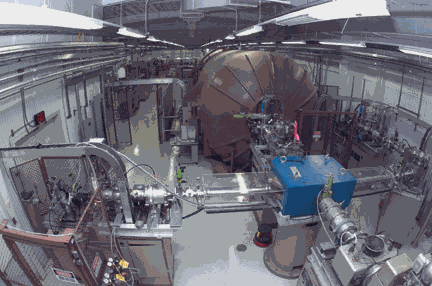
The 10-megavolt spectrometer at Livermore’s Center for Accelerator Mass Spectrometry is one of the most precise and high-throughput spectrometers in the world.
Balancing the Carbon BudgetKey Words: Amazon River basin, carbon-14, carbon cycle, carbon dioxide, Center for Accelerator Mass Spectrometry (CAMS), radiocarbon dating, sequestration.
For further information contact Tom Brown (925) 423-8507 (
brown92@llnl.gov).Science & Technology Review
The mission of Science & Technology Review is to
communicate, to a broad audience, Lawrence Livermore National Laboratory’s scientific
and technological accomplishments, particularly in the core mission areas of the
Laboratory. This publication does more than just inform people of these accomplishments;
it helps readers understand them and appreciate their value to the individual citizen, the
nation, and the world.
The monthly issues can be accessed in HTML and portable document format (PDF) by clicking on the dates at the left. Back issues of the Energy & Technology Review (the predecessor to S&TR) are also linked to this page.
You may access the complete online index of Science & Technology Review and Energy & Technology Review.
For information about S&TR, contact: str-mail@llnl.gov.
Back | S&TR Home | LLNL
Home | Help | Phone Book | Comments
Site designed and maintained by TID
Internet Publishing Team
Lawrence Livermore National Laboratory
7000 East Avenue, Livermore, CA 94550-9234
S&TR Office: (925) 423-3432
Operated by the University of California for the U.S. Department of Energy
UCRL-52000-06-3 | March 1, 2006
Lawrence Livermore Science & Technolgy Review
April 4, 2006