
Richard Melson
February 2005
Jerusalem Summit: 2004
http://forum.jerusalemsummit.org/
Over 150 leading thinkers and statesmen
from the US, Europe, Asia and Israel
took part in the 3-day Jerusalem Summit,
(Nov 27-30th, 2004), at Jerusalem's King David Hotel.
ASSESSING THE UN
Shabtai Shavit; Prof. Anne Bayefsky; Dr. Rachel Ehrenfeld; Dr. Dore Gold, Isi Leibler; Dr. Uzi Arad; General (Res.) Yaacov Amidror; Prof. Rafi Israeli; Dr. Manfred Gerstenfeld; Dr. Boaz Ganor
ALTERNATIVES TO THE OSLO PROCESS AND UNRWA
Dr. Avi Beker; Dr. Daniel Pipes; Congressman Robert Beauprez (R-CO); Itamar Marcus; Dr. Martin Sherman; Prof. Barry Rubin
BRINGING DEMOCRACY TO THE MOSLEM WORLD
Baroness Caroline Cox; Dr. Rivka Yadlin; William Tucker; Prof. Yossi Shain; Nonie Darwish; Prof. Khaleel Mohammed; David Pryce-Jones
MAKING CLOSED SOCITIES OPEN
Ana Palacio; General (res.) Prof. Isaac Ben-Israel; US Army Gen. Paul Vallely; Dennis Prager; Myles Munroe; Kenneth Meshoe
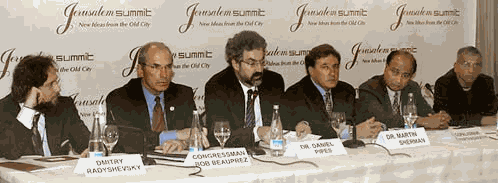
Press-conference of the Summit.
Jerusalem Summit-2004 Participants
27-30 NOVEMBER 2004
PROGRAM:Saturday, November 27, 2004 |
19:30
Welcoming reception20:00 Introduction: Dmitry Radyshevsky, Executive
Director of the Jerusalem Summit:
"Strategic Goal of the Jerusalem Summit, Developing Alternative Methods to Open
Closed Societies"
New models for global decision making |
|
Arab-Israeli conflict: Shifting the Paradigm from "Political" to "Humanitarian" |
|
Enhancing the Status of Moslem Women as a Means of Regime Change |
|
New Perspectives on the Koran: Focusing on Elements of Tolerance and Openness |
|
Geopolitical Crisis: Israel – Between Civilizations |
Choir
Greetings
: Rabbi Israel Meir Lau, Former Chief Rabbi of IsraelGifts to Jerusalem ceremony
Choir
Greetings:
Prof. Moshe Kaveh, President, Bar-Ilan UniversityGreetings: Knesset Member Dr. Yuri Shtern,
Chairman, Internal Affairs Committee, Christian Allies Caucus
Choir
Israel National Anthem and Cocktails
Sunday, November 28, 2004 |
Registration desk-8-9am
Morning Session 9:00-11:45AM
Assessing the UN: The Search for Alternative Approaches
Introduction:
Dr. Martin Sherman, Academic director of the Jerusalem Summit:Chairman: Isi Leibler, Senior Vice-President, World Jewish Congress:
"A New International Association of Democratic Countries"
Speakers:
Shabtai Shavit , Former head of the Mossad |
|
|
Prof. Anne Bayefsky , Hudson Institute |
Coffee break 10:30-10:45
Dr. Rachel
Ehrenfeld, International Center for the Study of Corruption: "The UN Corruption and
the Potential Harm to National Security: An American Case Study" |
|
Amb. Dr. Dore Gold, Former
Israel's Ambassador to UN: |
coffee break 11:45-12:00
Round Table Discussion 12:00-14:00pm
Chairman:
Afternoon Session 16:30-18:00
Chairman: Baroness Caroline Cox, UK House of the Lords:"The West: Islam and Islamism"
Screening of a movie: "Submission" written and directed
by Theo Van Gogh (who was murdered because of it in Holland)
and Hirsi Ali (Moslem Dutch MP)
Speakers:
Dr. Rivka Yadlin, Hebrew University: "Moslem Women’s Status: The Problematic" |
|
|
William Tucker , Columnist and Freelance Writer: "Polygamy and the roots of Terrorism" |
Dr. Parvin Darabi, Human Rights Activist: "Islam and Oppression of Women" |
Coffee break 18:00-18:15
Round Table Discussion 18:15-20:00
Chairwoman: Lt.-General(ret.) Orit Adato
Israeli participants:
Dinner 20:30
Greetings: Uri Lupolianski , Mayor of JerusalemMonday, November 29, 2004 |
Registration desk-8-9am
Chairman: Ana Palacio, former Foreign Minister of Spain: "Know thy enemy"
Speakers:
General (res.) Prof. Isaac Ben-Israel, Tel-Aviv University: "The Use of Technology in Fighting Poverty" |
|
Hon. Gopalaswami Parthasarathy , Former Indian High Commissioner for Pakistan: "Democracy and Political Developments in India and it's Neighborours" |
Coffee break: 10:15-10:30
|
Rev. Dr. Myles Munroe , International Third World Leader's Association: "Rediscovering the Human Race: Its Purpose and Power" |
Rev. Dr. Kenneth Meshoe , MP of South Africa, ACDP President: "Keys to Open a Closed Society" |
|
Mr. David Pryce-Jones : "Islam and Democracy" |
Coffee break 12:00-12:15
Round Table Discussion 12:15-14:00
Chairman:
Lunch 14:00
Guest speaker: General(Ret.) US Army Paul Vallely, FOX News commentator:
"Endgame-Blue Print for victory on the war on terrorism"
Afternoon Session 16:00-18:30
Shifting the Israeli-Palestinian Paradigm: Humanitarian, Rather than Political Solutions
Chairman:
Dr. Avi Beker, former CEO, World Jewish Congress:Speakers:
Dr. Daniel Pipes, US Institute of Peace: "UNRWA - The Heart of the Problem" |
|
|
Rep. Bob Beauprez (R-C0), U.S. Congress: "Tolerance? Really?" |
Coffee break: 17:15-17:30
Itamar Marcus, Director, Palestinian Media Watch: "Borders or Existential Conflict – Palestinian Formal and Informal Education" |
|
Dr. Martin Sherman, Tel-Aviv University: "Reframing the Palestinian Problem: A Humanitarian rather a Political Approach" |
|
Avigdor Liberman, Leader of "Israel Bei’tenu Party" |
Round Table Discussions (with coffee break) 18:30-20:30
Chairman: Prof. Barry Rubin, Director, Global Research in International Affair (GLORIA)
Center, Editor, Middle East Review of International Affairs (MERIA) Journal :
"Why Isn't the Arab-Israeli Conflict Already Finished?"
With Israeli participants:
Dinner 21:00 at Marakesh for foreign guests
Tuesday, November 30, 2004 |
Registration desk: 8-9am
Morning Session 9:00-11:00
Focusing on Elements of Tolerance and Openness in the Koran
Chairman: Gen.(ret) Mansour Abu Rashid, Amman Center for Peace and Development: "Projects and Activities in the Region to Establish a Good Relationship Between the Civil Societies"
Speakers:
Nonie Darwish, Arabs for Israel: "The Daughter of a 'SHAHID' Speaks Out for Change" |
|
Prof. Khaleel Mohammed , San Diego State University,California: "For Whom the Holy Land? A Koranic Answer" |
|
Prof. Mohanna Yousuf Haddad , Director of the Regional Office for Human Security, Amman: "Islamic Versus Post-Lliberal Ttolerance: Islamic Versus Post Lliberal Perspectives" |
|
Prof. Yohanan Friedmann , Hebrew University : "Tolerance and Coercion in Islam " |
coffee break 11:00-11:15
Round Table Discussion: 11:15-13:15
Lunch 13:30-15:30
Presentation of Senator Henry "Scoop" Jackson Award to Baroness Lady Caroline Cox (UK, House of the Lords)16:15-17:30-Closing Session
Geopolitical Crisis: Israel – Between Civilizations
Chairman:
Dmitry Radyshevsky, Executive Directorspeakers:
Prof. Xu Xin, Nanjing University, China : "Jewish Culture - a Value System Shared by All Mankind: a Chinese Perspective" |
Dr. Shimon Samuels, International Liaison of the Simon Wiesenthal Centre (Paris):"From A People Who Dwells apart to A Light unto the Nations" |
Prof. Ephraim Meir , Bar-Ilan University: "Israel - Between Civilizations" |
Round Table Discussions (with coffee break) 17:30-19:30
"Moving The Jerusalem Summit Forward"
Israeli Participants and audience suggestions:
Concluding Dinner : 19:30 Closing of the Summit
Chairman:
Jerusalem Council of Civilizations
Goals and Rationale
The Jerusalem Summit to be held on November 28, 2004, will launch the development of the Council ofCivilizations, which is intended to evolve into a new model for unifying the international community and providing it with an ethical compass.
The Council of Civilizations may be described as a "Voice of Ethics" for the international community, with the goal of working alongside the United Nations to fill the gap which exists in its structure.
A great deal of criticism has been voiced at the United Nations for failing in this task because it has no accountability and therefore does not command the respect of its member states. A true and lasting venue for constructive engagement must be built upon universal ethical principles: a foundation that all sides recognize as sacred. There is only one place in the world that commands the respect and awe of a majority of the world’s nations and its three major religions: Jerusalem, the Holy City.
The world needs a non-political body alongside the United Nations, where the best minds of the nations would develop universal ethical norms that would be observed by all the governments and serve as basis for solving humanity’s major global problems.
Unlike the current U.N. framework, governments will not be represented at the Council. It will be comprised of the best minds of 12 world’s principal civilizations. It is the civilizations that, with their distinct cultures and religious philosophies, are the real players on the world stage, and conflicts between them are the most dangerous and destructive. In the Council they will be represented by individuals who carry moral and intellectual authority with their respective civilizations.
These individuals will be chosen through independent public opinion polls, rather than nominated by their governments. In Persian and Arab civilizations, where most regimes are non-democratic and expression of free will is nonexistent, Council members will be selected from among exiled dissidents.
Council members will not be accountable to their governments, nor be dependent on them, either financially or legally. They will be guided solely by their conscience and major universal ethic principles
The membership of the Council and its Executive Committee will be fully rotated on the annual basis. The Executive Committee will draft the agenda, and administer the Council’s sessions in Jerusalem. Council members in their respective civilizations will be selected by regional Jerusalem Summits. JS Asia, JS America, and JS Europe have already been created.
Council will not issue any binding resolutions. Rather, it will strive to gain moral authority, so that its recommendations, developed in the spirit of moral clarity and caring for future generations, eventually become guidelines for the world leaders.
Principles of the Council of Civilizations
Gathering representatives of the civilizations (not
governments) which are shaping the fate of humanity: superpowers and clusters of countries
with common cultures.
Agreeing on the existence and definition of the common moral basis: the universal ethical
laws.
Searching solutions to the burning global problems on the basis of these values.
Three-fold actions:
1. Facilitate synergy of civilizations and search for morality-based
solutions.
2. Propagate these solutions and advise governments to adopt them.
3.Advance Global Education to Universal Moral Values.
The Jerusalem Summit will invite the United Nations to recognize the Council of Civilizations as an official entity which will work alongside the United Nations (in the format of an official,independent body ( an upper "House" or the model of the British "House of Lords") through procedures to be agreed upon.
The seat of the Council will be in Jerusalem with regional bureaus in each of the represented civilizations and a permanent bureau at U.N. Headquarters in New York.
Framework:
Admission to the Council of Civilizations is subject to recognizing the following realities:
1. The spiritual laws that serve as common basis to all religions must also serve as basis for taking decisions in all the human activities. Most important of these laws are:
Consciousness defines Being
Human life is sacred
People have equal rights and freedoms
All religions are facets of One Truth, and, once they are cleansed of the distortions,
will together reveal this Truth in its Entirety
Composition of the Council
Jerusalem has always served as a source for the universal concern for all the nations on earth. The Bible indictates that in addition to Israel, there are seventy ancient nations which are the roots of the diverse national groups and cultures which exist today and which are based on the number of descendants of Noah which are listed in the Book of Genesis, after the story of the great flood. Seventy names are recorded, and at the end of the section it states, ‘These are the families of Noah’s descendants, and from these nations were separated on on the earth after the flood" (Genesis 10:2). The Bible commands the people of Israel to bring seventy offerings on behalf of the seventy nations to the Temple on the Festival of Tabernacles to pray to the Almighty for continued life, sustenance and blessings for the seventy nations. Representatives of the seventy nations were present in Jerusalem at the time at the presentation of these offerings. The seventy nations are the main players in the modern world. Today they are categorized as the major superpowers that represent separate civilizations. Other individual civilizations are represented by the clusters of countries, or regional groups. The major threat to the world peace comes from the clashes of these civilizations.
South America
North America
North-Western (Catholic-Protestant) Europe
South-Eastern (Orthodox) Europe
Russia
India
China
South-East Asia
Persian civilization
Arab civilization
Turkic (Turkey and Central Asia) civilization
Africa
The Council of Civilizations will be composed of representatives of these twelve civilizations and the host representative from Israel. The Council of Civilizations will bring representatives of these diverse civilizations together in Jerusalem for the first time since Biblical times with the goal of creating unity through the translation of universal spiritual and moral laws into social structure and politics ("social engineering").
The Council of Civilizations is not a Religious/Ecumenical forum and it is not a purely secular Academic/Political institute. It is a framework for the best and purest minds and hearts of the civilized world – to guide the world towards spiritual and moral renewal.
What the Council will actually DO?
- It will develop an efficient Alternative Model for decision making in world politics: Decision through Wisdom and Ethics not through political or military Force (Realpolitik).
- It will give practical recommendations on how to solve the most crucial global problems through applying integrating consciousness, reconciling competing geo-political, geo-economic and geo-cultural projects.
A Forum of Spiritual and Lay Patrons representing the major faiths and professions is being formed toward the announcement of the development of the Council of Civilizations.
Philippines hosts Israel solidarity conference
Etgar Lefkovits. Jerusalem Post.
24 August 2004
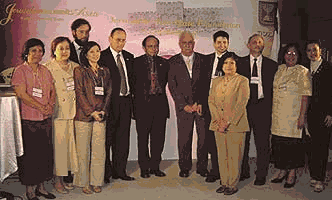
A group of 200 Christian leaders from seven Asian countries met in the
Philippines this week in a show of solidarity with Israel.
The first "Jerusalem Summit Asia," which was inspired by the Jerusalem
Summit held in Israel last fall, brought together Christian friends of Israel from the
Philippines, Singapore, Malaysia, Burma, Thailand, India, and Taiwan, along with members
of the Knesset's Christian Allies Caucus, which aims to garner the support of, and
work with, pro-Israel Christians around the world.
"This historic event heralds a new era of cooperation between Israel and Asia,"
said the co-chairman of the Christian Allies Caucus, MK Yuri Shtern (National
Union) in a telephone interview from Manila.
A declaration passed by the evangelical members of the conference at the conclusion of the
two-day meet called on their governments to move their embassies to Jerusalem, not to vote
against Israel at the United Nations, and to scrutinize the financial aid their countries
are providing to the Palestinian Authority, said Dmitry Radyshevsky, the
executive director of the Jerusalem Summit, an annual meeting of conservative
thinkers.
"This unprecedented gathering will have a long-lasting effect on Israeli-Asian
relations," said caucus director Josh Reinstein, adding that Singapore had
agreed to host a similar event in Asia next year.